
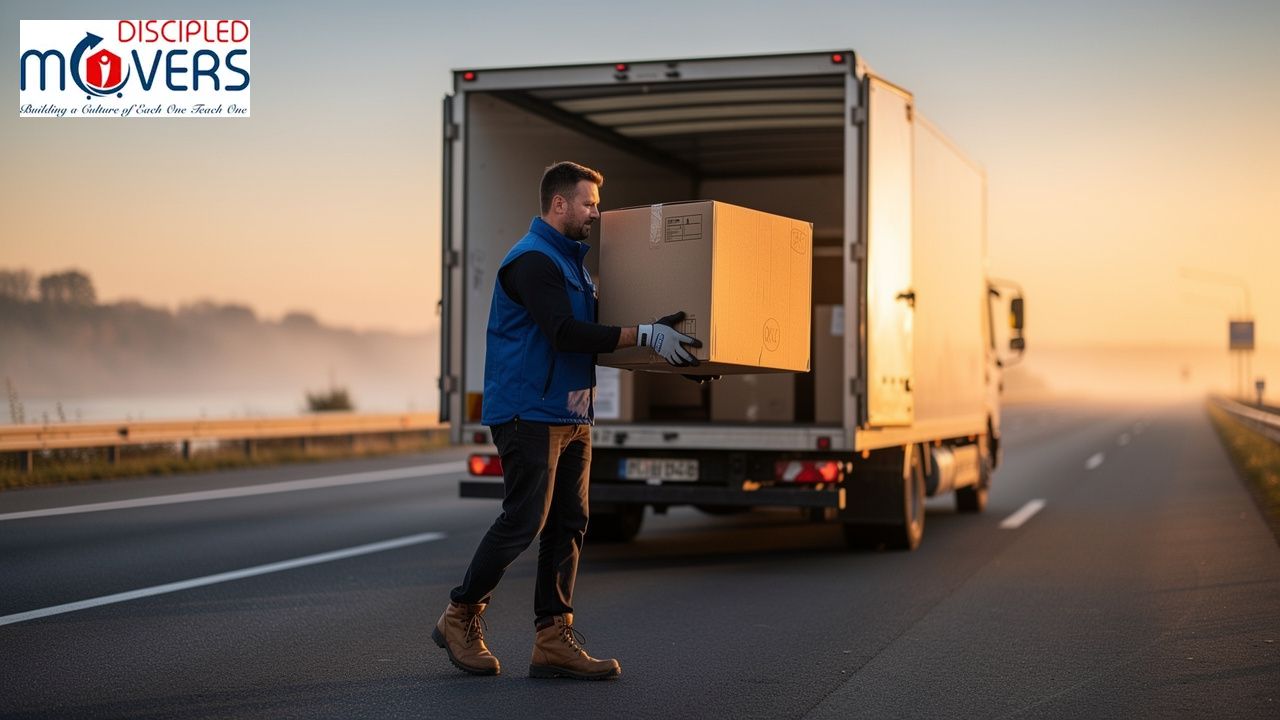
What Happens From Pickup to Delivery on a Long-Distance Move?
Summarize with
A long distance move has six stages: estimate, paperwork, pickup, transit, delivery, and claims if something breaks. Most long distance movers deliver within 1 to 16 days of pickup depending on mileage, and federal rules cap what you owe at the door: 100 percent of a binding estimate or 110 percent of a nonbinding one, per FMCSA.
Long Distance Moving Process at a Glance
The long-distance moving process takes 3 to 8 weeks from the first estimate to the last box and has six stages. Most of that time goes to planning and scheduling, not driving.
| Stage | What happens | Estimated timing |
|---|---|---|
| Estimate | Inventory survey in person or on video, written estimate | 1 to 2 weeks, ideally 6 to 8 weeks before the move |
| Paperwork | Order for service, bill of lading, coverage choice | Signed before loading |
| Pickup | Wrapping, packing, loading, final walk through | One day, 4 to 10 hours for most homes |
| Transit | Road time, possible transfer or storage | 1 to 16 days by distance |
| Delivery | Unloading, inspection, reassembly, payment | Half a day to a full day |
| Claims | Written claim for loss or damage | Within 9 months of delivery |
The gap between pickup and delivery is the part customers worry about most, so it gets the most space below.
Estimates and Booking
An estimate comes from someone counting your furniture, in person or on video, not from a phone call about bedroom count. FMCSA says the written estimate has to cover transportation, accessorial, and advance charges.
Reputable long distance movers book a survey 6 to 8 weeks out, which is also when summer and end of month dates are still open. Ask for the estimate type in writing. Binding means the number holds unless you add items or services. Nonbinding means the final price follows actual weight, but the mover cannot demand more than 110 percent of the quote at delivery. Anything above that is billed 30 days later.
Here is how that plays out. A nonbinding estimate of $4,200 caps the payment at the door at $4,620 (4,200 × 1.10). If the true charges come to $5,000, the remaining $380 arrives as a bill after delivery.
| Blue Tip: Video every room, plus the garage, closets, and attic, and make sure the estimator sees the same spaces. A garage full of boxes that first appears on pickup day is a classic reason nonbinding totals climb. |
Interstate Moving Process: Paperwork and Coverage
The interstate moving process runs on three documents: the written estimate, the order for service, and the bill of lading. It serves as both a receipt and contract. Interstate long distance movers movers must provide FMCSA’s Rights and Responsibilities booklet and Ready to Move brochure before you sign.
Before you sign the bill of lading, confirm:
- The price and estimate type match what you were quoted
- The valuation coverage you chose is the one printed
- Pickup and delivery windows are written down
- Any high value item is listed individually
- No page is blank
Coverage is where people lose the most money by not reading. Interstate movers must offer two options. Full Value Protection makes the mover liable for replacement value and applies automatically unless you decline it. Released Value costs nothing but pays no more than 60 cents per pound per article. In FMCSA’s liability guidance, a 50 inch TV weighing 25 pounds pays just $15 under Released Value (0.60 × 25).
| Blue Tip: Ask for Full Value Protection deductible options in writing. A higher deductible lowers the cost and still beats 60 cents a pound by a wide margin. |
Pickup Day With Long Distance Movers
Most homes take 4-10 hours to pickup. It begins with a walk through in which you compare the inventory with your estimate. Changes since the survey are identified prior to load rather than after.
The crew then pads furniture, removes furniture beds and tables and packs up whatever remains. Each item is given a numbered sticker and a condition note to be placed on the inventory. Do keep that list, as this is the “check against” list when you’re being delivered.
The loading of a puzzle is the same as that of a long distance movers; heavy dressers and appliances go on the bottom, lighter boxes are stacked up on the bottom, and straps are tightened across each layer. If the move is priced by weight, the truck is weighed empty, and then loaded at a certified weight scale. Ask for both weigh tickets.
Tall buildings and HOA communities add a step. Many require a certificate of insurance and a reserved freight elevator, so send those details a week ahead. Then walk the empty rooms with the crew lead before you sign.
Moving From Pickup to Delivery: Transit and Windows
After loading, your goods travel either on a dedicated truck for your move or a shared truck carrying multiple customers’ loads. Plenty of long distance movers default to shared loads because a full trailer costs less per customer to run, but shared loads may stop at other homes or pass through a warehouse.
Distance sets the minimum, and moving from pickup to delivery also depends on routing and load type. Federal hours of service regulations allow a driver to drive for 11 hours after 10 hours of off duty, about 500-600 miles per day.
Weather and stops are not included until at least three days have passed after you drove from Denver to Seattle (1,300 miles). The delay can be a day or two if I-70 is closed during winter in the mountains, or in Wyoming on I-80.
| Distance from Denver | Example route | Estimated window |
|---|---|---|
| Under 500 miles | Denver to Albuquerque | 1 to 3 days |
| 500 to 1,000 miles | Denver to Phoenix or Dallas | 3 to 6 days |
| 1,000 to 1,500 miles | Denver to Seattle or Atlanta | 5 to 10 days |
| 1,500 miles and up | Denver to Boston or Miami | 8 to 16 days |
A delivery window is specified in your bill of lading, not a date. A Call will be made 24 to 48 hours prior to the arrival. When on the road, ask who you are talking to when you answer the phone and if you receive a tracking link. A moving company that fails to identify that individual should be reconsidered.
Drivers check straps and the load at fuel and rest stops. Inquire about activities on overnight trips. A fenced yard is better than a street curb. If the house has not been built yet, storage in transit is charged for and obtain the monthly rate in writing.
Delivery Day and Damage Claims
The day of delivery, the crew will unload one by one, put furniture together and put boxes in the desired location. Before signing the inventory, make sure that each numbered item is covered on the form and write any damage on the inventory form.
- Count pieces against the inventory total
- Open fragile boxes while the crew is still there
- Photograph damage with the item’s sticker number visible
- Strike out any receipt language which exonerates the mover.
Inquire from long distance movers in advance who puts the furniture together and who removes packing trash. It should be included in the estimate.
| Blue Tip: Check TVs, glass tops and mattresses first. Once the truck is gone what’s left is hard to document at 9 p.m. when damage is found. |
In the event of damage or missing, 9 months from delivery to make a written claim. Within 30 days of being informed the mover is required to acknowledge it and pay, decline, or make a settlement offer within 120 days under federal rules. You can only receive a payout based on the coverage that’s written on the bill of lading.
Long Distance Moving Services and Estimated Costs
The cost of long distance moving services is based on shipment weight and miles; packing, stairs, and storage are additional charges. Estimated cost range of $4200- $6500 before packing a two bedroom home moving 1000-2000 miles.
| Home size | Estimated weight | 500 to 1,000 mi | 1,000 to 2,000 mi | 2,000+ mi |
|---|---|---|---|---|
| Studio or 1 bedroom | 2,000 to 3,500 lb | $1,800 to $3,200 | $2,600 to $4,200 | $3,200 to $5,000 |
| 2 bedroom | 4,000 to 6,000 lb | $3,000 to $5,000 | $4,200 to $6,500 | $5,200 to $8,000 |
| 3 bedroom | 6,000 to 9,000 lb | $4,500 to $7,500 | $6,000 to $9,500 | $7,500 to $12,000 |
| 4 bedroom or larger | 9,000 to 12,000+ lb | $6,500 to $10,500 | $8,500 to $13,500 | $10,500 to $17,000 |
All figures are estimates. Your written estimate sets the real price.
Other long distance relocation services show up as line items, also estimated:
- Full packing, two bedroom home: $600 to $1,800
- Shuttle truck when the big truck cannot reach your street: $300 to $900
- Stairs or long carry charges: $75 to $300
- Vehicle shipping, one car cross country: $900 to $1,800
Pricing from long distance movers also swings by season. June through August and the last week of any month book first and cost more.
Choosing Between Long Distance Moving Companies
Verify the name, address and USDOT number of the company in the FMCSA’s Registered Mover Database to ensure that the company is registered to move across state lines.
The main difference between long distance moving companies is whether the moving company you are dealing with owns the trucks and hires its own crew to move your belongings, or reserves the trucks and hires the crew from a moving company you’ve never encountered before. Here are 3 questions: Who has the Car Of Record, who loads my goods, and for whom do I call when the truck is in Kansas?
When comparing long distance movers, make sure to have all estimates on the same page: Type of estimate, coverage for valuation, delivery time, and what is and is not included in the cost of the estimate. Often a cheap quote on a quote will not include packing or stairs.
Get a Written Estimate for Your Move
Discipled Movers will perform a survey of your home in person or on video, and provide you with a binding or nonbinding quote in writing, and tell you your delivery window prior to signing. Our long distance movers are licensed in Colorado (HHG 00665).
Call (720) 409-1980 or email repdiscipled@gmail.com.
Frequently Asked Questions
How far is considered a long distance move?
Any distance more than 400 miles is considered long distance. Whether you move across state lines by mileage or not. It is an interstate move under FMCSA’s household goods regulations.
What are red flags with movers?
FMCSA lists 11. The Big Ones: estimate over the phone or online without anyone seeing the items & no written estimate, asking for cash or a large deposit & blank documents to be signed and a rental truck on the moving date. If you find one be sure to look for more.
How long can movers take to deliver?
First: 1-3 days if under 500 miles. 8-16 days if over 1500 miles. They can become overextended due to the shared load or weather conditions, and driver hours. Before you sign, be sure to get the window in writing.
Is it quicker for movers to load or unload?
Usually unloading is quicker. Loading is wrapping, dis-assembly, and the establishment of a stable load while unloading is the carrying and re-assembly. The approximate guideline is that it will take 4 to 5 hours to unload a house, if there are stairs and parking, that is, if it takes 6 hours to load it.
Is $100 per person a good tip for movers?
It is generous and fair for a full day on a large home, stairs, or a piano. The average rate is anywhere from $40 to $100 per day per mover. This equals $120 to $300 for a three man crew. Tip each pick-up and delivery crew separately as the two may be different.
What not to pack when moving?
Movers do not put flammables or hazardous materials like propane & gas, paint or aerosols, ammunition and fireworks into the truck. Carry perishables, plants or medicine, paperwork and jewelry. FMCSA points out that if you pack hazardous materials without informing your moving company, you may restrict the liability of your moving company.
How much is long distance moving?
That can be anything from approximately $1,800 for an apartment in the city, to $17,000 for a large home in the opposite part of the country. A two bedroom home moving 1,000 to 2,000 miles averages an estimated $4,200 to $6,500. Weight, distance, season, packing and stairs are all factors in the end cost.
What is the best company to use for long distance moving?
There’s no one size fits all company. Check for FMCSA registration, a written estimate with binding/nonbinding terms, coverage terms, own crews and clean complaint record. Obtain a minimum of three price quotes.
Is it cheaper to use pods or a moving company?
Even if you load or unload containers yourself, this can save money in the long run. An average cost for containers at this price range is $3000 to $5500 for a two bedroom home traveling more than 1,000 miles, compared to the full service mover’s cost of $4200 to $6500. Once you count your labor, the gap narrows.
Sources
- FMCSA: What Is a Binding Move Estimate?: Explains the 100 percent and 110 percent limits at delivery and that estimates must be based on an actual or virtual inspection.
- FMCSA: Liability and Protection: Describes Full Value Protection, Released Value at 60 cents per pound per article, and the nine month claim window.